Wudang Mountain: Where Daoist Sword Dance Was Born
The Sacred Peaks of Wudang
Rising from the misty highlands of northwestern Hubei Province, the Wudang Mountains have been a center of Daoist spiritual practice for over a thousand years. The range stretches across 321 square kilometers, with 72 peaks, 36 rocky cliffs, 24 ravines, and 11 caves forming a landscape so dramatic that it seems deliberately sculpted for contemplation. The highest peak, Tianzhu Feng (Heavenly Pillar), reaches 1,612 meters above sea level, its summit often wreathed in clouds that roll through the valleys below like rivers of white silk.
Wudang’s significance in Chinese culture extends far beyond its natural beauty. According to Daoist tradition, the mythological warrior deity Zhenwu (Perfect Warrior) attained enlightenment on these peaks, and the entire mountain range is consecrated to his worship. Emperors of the Ming Dynasty elevated Wudang to the status of the most important Daoist sacred site in all of China, surpassing even the Five Sacred Mountains in imperial favor. The Yongle Emperor (1402-1424) commanded the construction of a vast architectural complex on the mountain, declaring that Wudang should be “the most prominent mountain under heaven.”
Today, the Ancient Building Complex in the Wudang Mountains is a UNESCO World Heritage Site, recognized for its outstanding integration of architecture and landscape. Temples, palaces, and monasteries cling to cliffsides, nestle in valleys, and crown ridge tops, each one positioned according to Daoist principles of feng shui to harmonize with the natural energy of the mountain.
Zhang Sanfeng: The Immortal Who Created Internal Martial Arts
No figure looms larger in the history of Wudang martial arts than Zhang Sanfeng, the semi-legendary Daoist immortal credited with creating both Tai Chi Chuan and the Wudang internal martial arts system. According to tradition, Zhang Sanfeng lived on Wudang Mountain during the Song or Yuan Dynasty (accounts vary by several centuries), where he spent decades in meditation and alchemical practice.
The most famous story of Zhang Sanfeng’s martial arts epiphany describes him witnessing a fight between a snake and a crane (or magpie, in some versions). The crane attacked with sharp, direct strikes, but the snake yielded and redirected each assault with circular, flowing movements. From this observation, Zhang Sanfeng is said to have realized that softness could overcome hardness, that yielding could defeat aggression, and that circular motion could neutralize linear force. These insights became the foundation of the neijia — internal martial arts — tradition.
While historians disagree about whether Zhang Sanfeng was a historical person or a composite of several Daoist figures, his symbolic importance is undeniable. He represents the Daoist ideal of the sage who achieves immortality not through brute force but through harmony with the natural world. The martial arts attributed to him — Tai Chi, Baguazhang, and Xingyiquan — all embody this principle, using internal awareness and refined body mechanics rather than muscular strength to generate power.
Zhang Sanfeng’s legacy is so profound that the external Shaolin and internal Wudang traditions are often presented as the two great pillars of Chinese martial arts, each representing a fundamentally different approach to understanding combat, health, and spiritual cultivation.
The Tai Yi Five Element Sword
Among the many martial arts practiced on Wudang Mountain, swordplay holds a position of special reverence. The Daoist sword is not merely a weapon — it is a ritual instrument, a symbol of the practitioner’s aspiration to cut through illusion and attachment, and a vehicle for cultivating and directing qi through the body.
The most distinctive Wudang sword form is the Tai Yi Wu Xing Jian (Tai Yi Five Element Sword), a sequence that encodes the Daoist Five Element theory (wu xing) into martial movement. The five elements — metal, water, wood, fire, and earth — represent different qualities of energy and phases of transformation. In the sword form, each element corresponds to a specific type of sword technique and a particular quality of movement.
Metal techniques are sharp and decisive, embodying the cutting quality of a blade. Water techniques flow and redirect, following the path of least resistance. Wood techniques expand and grow, reaching outward with spiraling force. Fire techniques are explosive and ascending, channeling the rapid upward energy of flame. Earth techniques are stable and grounded, providing the foundation upon which all other elements depend.
The sword form moves through these elements in sequences that follow the generating cycle (sheng cycle) of Five Element theory: wood feeds fire, fire creates earth, earth bears metal, metal collects water, and water nourishes wood. This creates a flowing, circular practice where each technique naturally gives rise to the next, and where the practitioner experiences the fundamental Daoist insight that all things are interconnected and mutually generative.
Internal vs External: Two Paths Up the Same Mountain
The distinction between internal (neijia) and external (waijia) martial arts is one of the most discussed topics in Chinese martial arts theory, and Wudang stands as the traditional home of the internal approach. External martial arts, exemplified by Shaolin Temple traditions, emphasize muscular strength, speed, and physical conditioning. They train the body first, developing hardness and power through repetitive drilling and conditioning exercises.
Internal martial arts take the opposite approach. They begin with the mind and the breath, cultivating awareness of internal energy (qi) and using that awareness to guide physical movement. Rather than conditioning the muscles to generate force directly, internal arts train the connective tissues — tendons, ligaments, and fascia — to transmit force generated by the whole body working as an integrated unit. Power comes not from the arms but from the ground, traveling through the legs, directed by the waist, and expressed through the hands.
The internal approach requires extraordinary patience. External martial artists can develop impressive fighting ability within a few years of dedicated training. Internal martial artists may need a decade or more before their body mechanics are refined enough to express genuine internal power. But the internal arts offer compensating advantages: they can be practiced well into old age, they promote health and longevity rather than wearing the body down, and at the highest levels they produce a kind of power that external methods cannot match — the ability to defeat a stronger opponent with seemingly effortless technique.
Wudang sword practice embodies this internal approach perfectly. The sword becomes an extension of the practitioner’s qi, moving not because the arm muscles force it but because the body’s internal energy flows through it. A Wudang swordsman’s blade appears to move of its own volition, guided by an intention that originates deep within the practitioner’s center.
Living Tradition: Wudang Monks Today
The Cultural Revolution (1966-1976) devastated Wudang’s monastic community, as it did religious institutions throughout China. Monks were dispersed, temples were damaged, and centuries of oral transmission were interrupted. But the tradition survived, preserved by a handful of dedicated practitioners who continued their training in secret.
Today, Wudang is experiencing a remarkable revival. The Chinese government has invested heavily in restoring the mountain’s architectural heritage, and a new generation of Daoist monks is training in the traditional martial arts. Schools on the mountain accept both Chinese and international students, and Wudang sword forms have become popular performance pieces at martial arts demonstrations worldwide.
Master Yuan Xiu Gang, a 15th-generation Wudang Longmen lineage holder, is among the most prominent contemporary teachers. His demonstrations of Wudang swordplay — fluid, powerful, and eerily precise — have inspired thousands of students to travel to Wudang Mountain to study. Other notable teachers include Master Zhong Xiu Wu and Master Chen Shiyu, each carrying forward specific lineages of Wudang martial arts with their own emphases and interpretations.
Training the Wudang Sword
For those unable to travel to Wudang Mountain, training in Chinese swordsmanship can begin with a quality practice sword. Chinese Swordsmanship: The Yang Family Taiji Sword Tradition by Scott M. Rodell provides an excellent English-language introduction to Chinese sword mechanics, including grip, cutting angles, and the all-important principle of extending qi through the blade. For safe partner practice, the Cold Steel Chinese Sword Trainer offers a durable, non-sharp alternative that approximates the weight and balance of a traditional jian.
The Wudang Mountains remain one of the most extraordinary places on Earth — a site where architecture, landscape, philosophy, and martial art converge into something greater than the sum of its parts. The sword dances practiced on these misty peaks are not relics of a bygone era but living expressions of a worldview that sees no separation between spiritual cultivation and physical skill. For more stories about Chinese cultural heritage, visit huaxiaink.com.
Explore the Wudang Mountains and their cultural significance on Wikipedia.
You May Also Like
 4:21
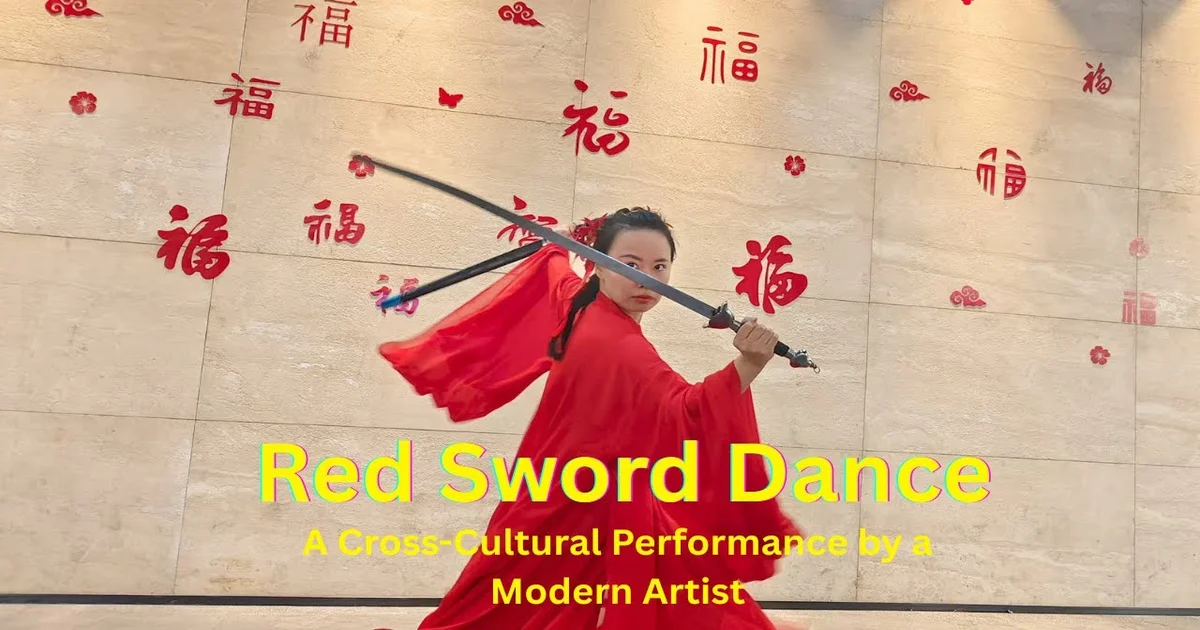
4:21 Chinese Sword Dance: Where Martial Arts Meets Poetry in Motion
 8:02
8:02 Drunken Fist Kung Fu: The Martial Art That Pretends to Be Drunk
 6:10
6:10 Praying Mantis Kung Fu: The Insect-Inspired Fighting System
The Philosophy of Tai Chi: Movement as Meditation
Recommended Products
Products related to this topic, automatically recommended by Amazon:
As an Amazon Associate, we earn from qualifying purchases.