When a Chinese Guzheng and a Western Cello Meet on 'Lemon Tree'
An Unlikely Duet
A 1990s German pop song. A 2,500-year-old Chinese zither. A Western cello. And a street corner somewhere in France. This shouldn’t work — but it does, beautifully, and six million people have watched it happen.
The song is Lemon Tree by Fool’s Garden, a wistful 1995 hit about sitting alone in a boring room on a rainy Sunday afternoon. The guzheng player is Pengpeng Jingxuan (碰碰彭碰彭), a young Chinese musician who has built a following performing guzheng covers on the streets of France. The cellist is Felix Nunes, and the arrangement turns a song about isolation into a conversation between two musical worlds.
The Guzheng Meets Its Match
The guzheng is a 21-string plucked zither with a sound that Westerners often describe as “like water over stones” — flowing, crystalline, delicate. The cello, by contrast, is warmth and weight: a voice that resonates from deep in the chest. Put them together and you get something neither can achieve alone.
In this arrangement, the guzheng handles the melody and the signature rhythmic patterns of Lemon Tree, while the cello provides the harmonic foundation and emotional gravity. The guzheng’s plucked clarity against the cello’s sustained resonance creates a texture that feels simultaneously airy and grounded — like looking through a window at rain while sitting by a fire.
Who Is Pengpeng Jingxuan?
Jingxuan is part of a new generation of Chinese musicians who take their instruments out of concert halls and into public spaces. She performs regularly on the streets of France, bringing the guzheng to audiences who might never step inside a traditional music venue.
Her approach is deliberate: by playing in public, she turns the guzheng from a cultural artifact into a lived experience. Passersby don’t need to know the instrument’s 2,500-year history or understand its role in Chinese scholarship. They just need to stop, listen, and feel — and the music does the rest.
Her YouTube channel features guzheng covers of everything from traditional Chinese pieces to Western pop hits, all filmed in evocative outdoor settings across France and Europe.
Why “Lemon Tree” Works on Guzheng
Lemon Tree is deceptively simple. The melody is straightforward, the chord progression is gentle, the mood is melancholy without being dramatic. These qualities happen to suit the guzheng perfectly:
The plucked quality mirrors the song’s introspection. Lemon Tree is about being alone with your thoughts, and the guzheng’s discrete, separated notes have that same quality — each one a complete thought, with space around it for reflection.
The cello fills what the guzheng can’t. The guzheng’s strength is melodic clarity; its weakness is sustain. A cello can hold a note for as long as the player’s bow arm allows. Together, they cover the full range of musical expression — from the pointed to the flowing, from the specific to the ambient.
The cultural contrast amplifies the emotion. There’s something about hearing a European pop song through an Asian instrument that makes you hear it fresh. The familiar becomes unfamiliar, and in that unfamiliarity, you notice details — a subtle chord change, a melodic turn — that the original arrangement let you overlook.
Street Performance as Cultural Bridge
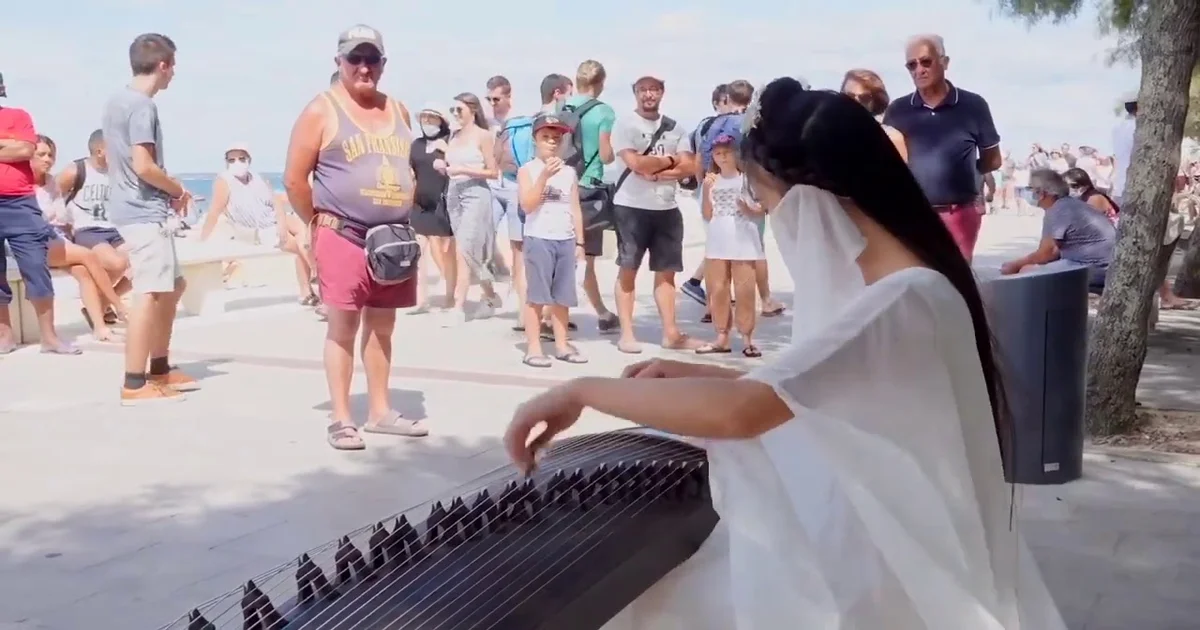
This video is more than a cover — it’s a statement about how culture travels. When Jingxuan sets up her guzheng on a French street corner, she’s not performing for Chinese expatriates. She’s performing for anyone who walks by — locals, tourists, children, elderly couples on their evening walk.
And they stop. They always stop. The guzheng’s visual beauty (its long rectangular body, its bridges and strings, the player’s focused precision) draws the eye. Then the sound holds them. Then the song — familiar enough to be accessible, strange enough to be compelling — does the rest.
This is cultural exchange in its most organic form: not curated by institutions, not mediated by policy, just one musician sharing what she loves with whoever happens to be there.
The Bigger Picture
Jingxuan and Felix’s Lemon Tree is a small, perfect example of what happens when we stop thinking of musical traditions as sealed rooms and start thinking of them as doors. The guzheng doesn’t lose its Chinese identity by playing a German pop song — it demonstrates that its identity is more flexible, more generous, more universal than anyone assumed.
As one YouTube commenter put it: “I never knew I needed to hear a Chinese harp play ’90s European pop, but here we are, and it’s perfect.”
Explore more: guzheng beat-dropping
Sources: Guzheng on Wikipedia
You May Also Like
 5:18
5:18 Hulusi: The Gourd Flute of Yunnan's Tropical Valleys
 8:42
8:42 Morin Khuur: The Horse-Head Fiddle That Sings the Steppe
 6:50
6:50 Yangqin: The Chinese Hammered Dulcimer That Bridged East and West
Guzheng — The Chinese Zither With 2,500 Years of Elegance
Recommended Products
Products related to this topic, automatically recommended by Amazon:
As an Amazon Associate, we earn from qualifying purchases.