Dragon Boat Festival Through Liziqi's Eyes — Zongzi, Rice Fields, and a 2,000-Year Memory
A Festival Told Through Sticky Rice and Bamboo Leaves
Liziqi’s videos need no narration. In just six minutes, she tells the entire story of Dragon Boat Festival (端午节, Duanwu) without a single spoken word — through hands that harvest reed leaves, fingers that fold zongzi, and a kitchen that fills with steam from a bamboo steamer. Over 21 million people have watched this video, and the reason is clear: it shows what the festival actually feels like, not what a textbook says it should mean.
Dragon Boat Festival falls on the fifth day of the fifth lunar month, usually in June. It is one of China’s oldest holidays, and unlike Spring Festival’s exuberance or Mid-Autumn’s elegance, Duanwu carries a hint of sorrow beneath its celebration — because it begins with a man who drowned.
The Scholar Who Chose the River
Qu Yuan (屈原) lived during the Warring States period, around 340–278 BCE. He was a poet, a minister, and a patriot who served the State of Chu. When corrupt officials persuaded the king to ally with the increasingly powerful State of Qin — the very state that would eventually conquer all of China — Qu Yuan objected. He was exiled for his dissent.
Years later, Qin’s army captured Chu’s capital. Upon hearing the news, Qu Yuan walked into the Miluo River and drowned himself. According to legend, the local people raced out in boats to save him — too late. They threw balls of sticky rice into the water so the fish would eat the rice instead of Qu Yuan’s body. They beat drums to scare away river creatures.
That is the origin story. The boat races became dragon boat racing. The rice balls became zongzi. The drums became the thunderous heartbeat of every Duanwu celebration.
What Zongzi Really Is
Zongzi (粽子) is glutinous rice stuffed with savory or sweet fillings, wrapped in bamboo or reed leaves, and steamed for hours. The wrapping technique is an art form itself — a properly folded zongzi is a perfect tetrahedron, tight enough that the rice doesn’t leak, loose enough that the steam can penetrate. Tying it with string requires exactly the right tension.
In Liziqi’s video, she makes “pillow zongzi” (枕头粽) — a rectangular style from Sichuan. She soaks the rice overnight, prepares a filling of marinated pork belly and salted egg yolk, folds each zongzi by hand, and steams them in a bamboo steamer over a wood fire. The entire process takes most of a day. No shortcuts. No machines. Just skill, patience, and the quiet rhythm of rural life.
The result is something no store-bought zongzi can match: the rice is infused with the fragrance of bamboo leaves, the pork has melted into the surrounding grains, and the egg yolk provides a rich, salty counterpoint. Opening a freshly steamed zongzi is like opening a small gift — and that, perhaps, is the point.
The Dragon Boats: Where Grief Becomes Power
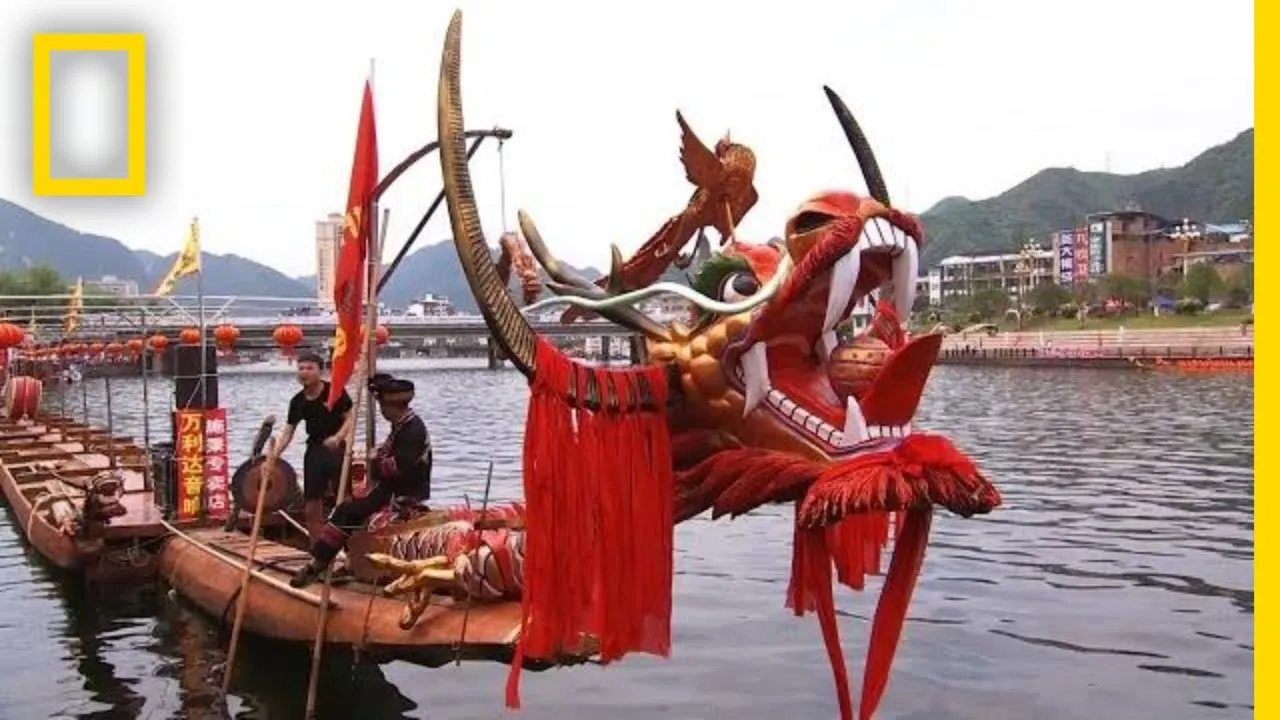
While zongzi is the domestic heart of Duanwu, dragon boat racing is its public face. Teams of 20–80 paddlers sit in long, narrow boats carved to resemble dragons, racing to the rhythm of a drummer seated at the bow. The sport demands absolute synchronization — one mistimed stroke can capsize the entire boat.
Modern dragon boat racing has become an international sport, with competitions held in over 50 countries. But at its core, it remains a Chinese ritual. The boats are blessed before the race. The drums echo across the water like a heartbeat. And whether the paddlers know it or not, every stroke is a reenactment of that desperate race to save a poet who chose death over compromise.
Why Duanwu Matters Today
Dragon Boat Festival is not just about commemorating Qu Yuan. It’s about what he represented: integrity in the face of corruption, loyalty that exceeds self-interest, and the belief that some values are worth dying for. These are not ancient abstractions. In a world of institutional decay and moral flexibility, Qu Yuan’s choice — to walk into the river rather than serve a broken state — resonates with uncomfortable clarity.
The festival is also profoundly practical. Duanwu marks the transition from spring to summer in the Chinese agricultural calendar. The “five poisons” (五毒) — snakes, scorpions, centipedes, toads, and spiders — become active around this time. Traditional customs include hanging mugwort (艾草) and calamus (菖蒲) on doorways to repel insects, wearing five-color silk threads for protection, and drinking realgar wine (雄黄酒). These are not superstitions so much as accumulated wisdom: mugwort is, in fact, a natural insect repellent.
The Quiet Festival
Compared to the fireworks and fanfare of Spring Festival, Duanwu is quiet. The zongzi are made at home, often across generations — grandmothers teaching grandchildren how to fold the leaves, fathers arguing about whether savory or sweet filling is better. The dragon boat races are communal but not commercial. There are no gift-giving obligations, no pressure to spend.
And perhaps that’s why Liziqi’s video resonated so deeply. She didn’t explain the history or analyze the symbolism. She simply showed the festival as it is lived — hands in water, steam rising, the patience of making something by hand that could be bought in minutes. In her world, the fastest way and the right way are not the same, and the difference matters.
Explore more: Dragon Boat Festival’s ancient origins · the history of zongzi
Sources: Dragon Boat Festival on Wikipedia
You May Also Like
 3:42
3:42 Drones Save Lives in China Floods: Heavy-Lift UAVs Airlift People and Supplies When Roads Vanish
 3:03
3:03 Europe's Heatwave Crisis: How Chinese Cooling Wisdom Outperforms Air Conditioning
 1:33
1:33 Saturation Rescue: How China Rewrites the Rules of Disaster Response
 3:21
3:21 Dragon Boat Races: The Ancient Sport Born From Grief
Recommended Products
Products related to this topic, automatically recommended by Amazon:
As an Amazon Associate, we earn from qualifying purchases.